


Electronic Invoicing
ViDA Directive: electronic invoicing at EU level
The ViDA directive finally adopted by the EU! What's at stake for electronic invoicing in France and beyond? What are the impacts and key dates for...

6
min
E-invoicing is no longer a distant regulatory concern for UK businesses. With HMRC confirming a mandatory B2B e-invoicing framework from 1 April 2029, the question is no longer whether to act but how soon.
At the heart of this transition sits one network that most finance and IT teams have yet to fully explore: Peppol. Already adopted by 98 countries and 1.4 million organisations worldwide, Peppol is rapidly becoming the global standard for structured, secure and interoperable invoice exchange.
What exactly is Peppol? How does it relate to the UK mandate? And what's the difference between Peppol BIS and PINT?
This article covers everything UK businesses need to know. 👇
Summary
The most common misconception: Peppol (Pan-European Public Procurement Online) is not a file format. It is not a government portal. It is not a competitor to UBL or XML. It is a secure, standardised exchange infrastructure.
Created in 2008 as part of a European initiative, this network was originally designed to standardise exchanges in public procurement (B2G). It gradually evolved to support all B2B commercial transactions before expanding across the rest of the world.
At its core, Peppol is three things:
➡️A global network: a worldwide infrastructure of certified Access Points that route structured business documents between organisations. Once connected, you can exchange invoices, purchase orders and credit notes with any other participant on the network, anywhere in the world.
➡️A set of open standards: Peppol defines the document formats, the required data fields, and the validation rules every document must pass before transmission. This standardisation is what makes interoperability possible: a Peppol invoice from a supplier in Germany can be processed seamlessly by a buyer's system in the UK.
➡️A governance structure: Governance is overseen by OpenPeppol through the Peppol Interoperability Framework (PIF), which defines the development, maintenance and compliance management of all specifications. OpenPeppol works with more than 23 local Peppol Authorities worldwide.
Its founding principle: "Connect once, connect to all." A single connection to an Access Point is all it takes to exchange documents with any other participant, no bilateral integration, no technical friction.
As of 2025, 1.4 million organisations across 98 countries are connected, supported by over 300 certified access points.
Peppol is built on the 4-corner model, named for the four parties involved in every document exchange.
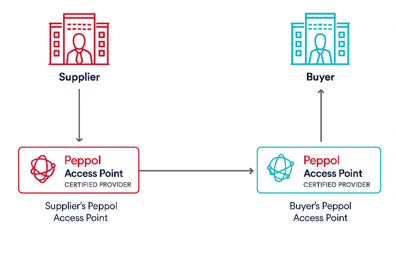
Corner 1 (The supplier): Creates an invoice in their accounting or ERP system, structured in the agreed Peppol format (typically UBL XML for UK transactions).
Corner 2 (The supplier's Access Point): A certified Peppol service provider. It validates the invoice against Peppol rules, looks up the buyer's Access Point in the Peppol Directory, and transmits the document securely across the network.
Corner 3 (The buyer's Access Point): Receives the incoming invoice, performs its own validation, and delivers the structured data to the buyer's ERP or AP automation platform.
Corner 4 (The buyer): Receives the invoice data directly into their system — no re-keying, no scanning, no manual data entry. The invoice is ready for matching and approval.
📌Important: businesses cannot connect to Peppol directly. The network is only accessible through certified Access Point providers, organisations approved by their national Peppol Authority. When evaluating vendors, always confirm they hold current Peppol Access Point certification.
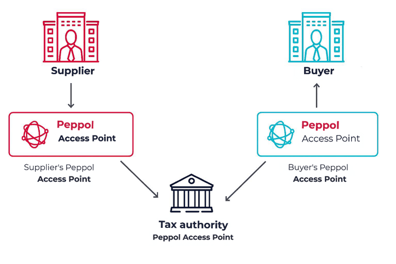
Some countries have adopted a more advanced variant: the 5-corner model (also known as Continuous Transaction Controls, or CTC), which adds the tax authority as a fifth actor enabling real-time transmission of fiscal data to the government alongside the invoice exchange. The UK is expected to begin with a 4-corner model, with the possibility of adding digital reporting to HMRC at a later stage.
Peppol BIS Billing 3.0 is the European standard for e-invoicing on the Peppol network. Based on the EN 16931 standard and the UBL format, it is the default format for all intra-European exchanges.
Belgium made Peppol BIS mandatory for all B2B invoices from 1 January 2026.
NHS suppliers in the UK already use Peppol BIS 3.0 through a certified Access Point.
PINT (Peppol International) is an emerging global format developed by OpenPeppol to support cross-border e-invoicing between different national implementations. It is particularly relevant for businesses invoicing across multiple countries outside the EU.
A practical example: a German business invoicing a Swedish client uses Peppol BIS 3.0 both follow the European standard. That same business invoicing an Australian client would use PINT, as Australian tax rules are not covered by the European version.
E-invoicing is not a new concept. It dates back to the early 2000s, with Chile as the global pioneer. Two main models have since emerged worldwide:
The clearance model (centralised): the tax authority validates each invoice in real time before it reaches the recipient. Adopted by Italy, Mexico, Brazil and Turkey. Maximum fiscal control, but all flows pass through a central government platform.
The post-audit model (decentralised): invoices flow freely between private operators, with the tax authority receiving data via near real-time e-reporting. Adopted by France, Germany and Belgium and the model the UK is signalling for 2029. Peppol acts as the interoperability network connecting all participants.
The global trend is moving towards a convergence of both models, driven by VIDA (VAT in the Digital Age): the fluidity of the decentralised approach, combined with near real-time fiscal control.
Yes, and more widely than many UK businesses realise.
Since 2019, the Crown Commercial Service has mandated that all UK central government suppliers must be able to send and receive invoices via the Peppol network. This covers every NHS Trust and central government department. Any business that supplies to the public sector is already operating in a Peppol-mandatory environment whether they know it or not.
Beyond central government, large private sector buyers, particularly in retail, manufacturing and financial services are increasingly requiring Peppol-capable suppliers as they modernise their own AP operations. This is creating a de facto market requirement ahead of any formal mandate.
HMRC is an active participant in OpenPeppol's governance structures, and a dedicated UK Peppol Working Group has been established within OpenPeppol with the mission to develop UK-appropriate Peppol specifications and provide a testing environment for service providers.
The UK e-invoicing mandate: what's confirmed?
The mandate was confirmed at the November 2025 Budget. From 1 April 2029, all VAT-registered businesses must exchange VAT invoices electronically for B2B and B2G transactions. PDFs, Word files and scanned images will no longer count as VAT-compliant invoices.
Further details on accepted formats, transmission channels and enforcement mechanisms are expected at Budget 2026.
The direction is clear and the clock is ticking. Yet according to the PPN Annual Survey 2026, The readiness gap is real and a vast majority of UK businesses are yet to take meaningful action:
|
✅ Already prepared |
4% |
|
🟡 Aware, but not yet prepared |
29% |
|
🔄 Currently reviewing processes |
40% |
|
❌ Had not heard of the mandate |
16% |
For organisations that have already embarked on their Purchase-to-Pay (P2P) automation journey, the transition will be significantly smoother. Having already digitalised core processes: invoice capture, approval workflows, vendor management, ERP integration, they have laid the foundations that e-invoicing compliance will build upon. Less disruption, faster implementation, and a clearer path to maximising ROI.
The case for acting now: businesses that implement Peppol-compliant e-invoicing now avoid three risks:
The UK mandate sits within a much broader global movement: the European ViDA initiative (VAT in the Digital Age), driven by the European Commission, which aims to harmonise e-invoicing and VAT reporting across the EU by 2030.
For UK businesses with EU trading partners, this is directly relevant: as Belgium (January 2026), France (September 2026) and other EU member states roll out Peppol-based mandates, UK suppliers to those markets will face Peppol requirements regardless of domestic UK legislation.
Peppol is not just a UK compliance network, it is the infrastructure connecting UK businesses to their European and global trading partners, today and tomorrow.
✅Step 1 — Choose a certified Peppol Access Point provider Confirm your e-invoicing vendor holds current, valid Peppol Access Point certification. Access Points must renew certification regularly, always verify current status.
✅Step 2 — Register your Peppol ID Every organisation has a unique identifier on the network. In the UK, this is typically based on your company registration number (e.g. GB:COL:12345678) or VAT number. Your Access Point provider manages this registration and publishes your details to the Peppol Directory.
✅Step 3 — Integrate with your ERP or finance system Connect your Access Point to your ERP (SAP, Oracle, Microsoft Dynamics, etc.) via API, SFTP or a certified ERP connector. The depth and reliability of this integration is the most critical technical factor in a successful Peppol implementation.
✅Step 4 — Test with your key trading partners Run end-to-end tests before going live. Verify that invoice data flows correctly from your ERP through Peppol and into the recipient's system without errors. Your Access Point provider should offer a sandbox test environment.
✅Step 5 — Manage supplier and buyer onboarding Not all trading partners will be Peppol-ready immediately. A robust e-invoicing solution handles mixed environments processing Peppol e-invoices and PDF or paper invoices through the same pipeline
Learn more about global e-invoicing in this report👇

Sources
The Definitive Guide to Purchase to Pay in the UK, PPN Annual Survey 2026
Useful links:
Peppol Directory: Peppol Directory - Search
OpenPeppol Members: Full members list - OpenPeppol
ITESOFT is a certified Peppol Access Point, delivering a solution that is natively Peppol-ready, supporting Peppol BIS, PINT and all major EDI formats (EDIFACT, UBL, CII…) through a single omnichannel platform.
Whether your trading partners are in the UK, Belgium, Germany, France or Singapore, ITESOFT ensures your invoices flow without friction, today and as mandates evolve.
💡Our recommendation: when selecting your e-invoicing provider, verify that they hold current Peppol Access Point certification and support both BIS and PINT for your international flows. Do not wait for the 2026 Budget details to begin your assessment.
👉Learn more about ITESOFT's Peppol-ready solution! Consult our solution page.

Electronic Invoicing
ViDA Directive: electronic invoicing at EU level
The ViDA directive finally adopted by the EU! What's at stake for electronic invoicing in France and beyond? What are the impacts and key dates for...
AP Automation
Finance automation: Preparing the Future of AP Functions
As with any significant project, there are always some key steps that you should consider taking, automation in finance is no different.
Electronic Invoicing
E-invoicing around the world: what is the current situation?
Overview of e-invoicing: discover the models, standards and requirements for each country to fully understand mandatory electronic invoicing.